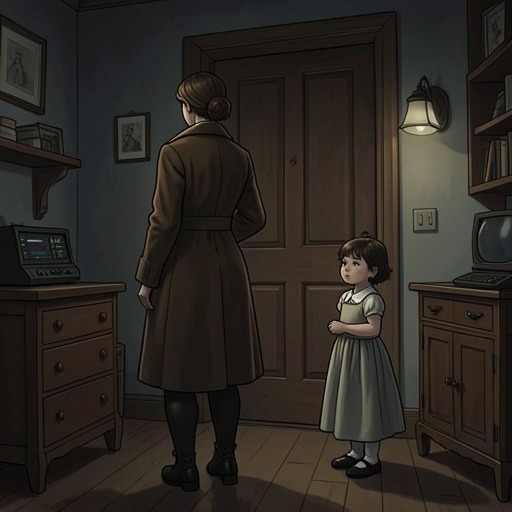
Kay Kafka and Cressida Maciver’s stepmother–stepdaughter conflict
Good Morning, Midnight (Reginald Hill Edition)The conflict between Kay Kafka and Cressida Maciver is presented chiefly through Cressida’s own bitter account: she rejects Kay as a stepmother, refuses her authority after her father’s death, and later treats Kay’s presence as grounds for renewed confrontation. The account is sharply one-sided, but its repeated images of control, exclusion, and contested belonging make the relationship a persistent fault line in the Maciver family.
The Origins of Cressida’s Hostility
Cressida introduces Kay to Ellie Pascoe as someone whose name has appeared in newspapers and whom, she assumes, people would remember. Her summary is blunt: Kay “is a pain in the arse anyway.” When Ellie asks whether Cressida dislikes her stepmother, Cressida answers that Palinurus Maciver Junior “Hates her guts.” The force of the exchange makes clear that Cressida regards the hostility not as a passing irritation but as a defining feature of the family relationship.
Cressida contrasts her own response, and Palinurus Maciver Junior’s, with Helen Dunn’s attachment to Kay. In her telling, Helen was nine when their father remarried, while Cressida and Palinurus Maciver Junior were older; Cressida describes them as having had time to harden themselves against Kay’s influence. She says that she and Palinurus Maciver Junior tried to get Helen away from Kay, but that Helen became hysterical at the prospect of separation. Cressida interprets Helen’s resistance as evidence of Kay’s hold over her, calling Kay controlling. That is Cressida’s judgment, not an independently established account of Kay’s intentions, and her openly contemptuous language makes the limits of her perspective important.
Rejection of Kay’s Authority
The conflict became a question of guardianship after Cressida’s father died. Cressida recalls that this was ten years earlier: Palinurus Maciver Junior was already of age, but she was seventeen and, officially, still needed a responsible adult to care for her. She was determined that Kay would not fill that role, even if avoiding her meant living with the eccentric aunt Cressida calls Vinnie. Cressida identifies this relative as Lavinia Maciver, her father’s only sister; the fact that she chose a blood relative despite her dismissive description of her aunt underscores how strongly she rejected Kay’s claim to authority.
The choice marks a practical as well as emotional break. Cressida presents Kay not simply as someone she disliked, but as a person whose care she would refuse at a moment when she could not yet act wholly independently. Her account also divides the siblings’ responses: Palinurus Maciver Junior shared her hostility, while Helen, much younger when Kay entered the family, remained attached to Kay. Cressida’s resentment therefore sits within a wider family fracture, but the evidence gives her interpretation of that fracture rather than a balanced account from all three siblings.
Cressida extends her distrust to Helen’s marriage. She suggests that Kay may have selected Jason Dunn as a husband for Helen because he was not intellectually imposing, while describing him as physically attractive and recounting his reputation as a sexual partner. This is an accusation made by Cressida, not confirmation that Kay arranged the marriage or that Jason Dunn was chosen for the reason she proposes. Its significance lies in how far Cressida’s suspicion reaches: she interprets Kay’s influence over Helen as extending beyond childhood and into Helen’s adult relationships.
Conflict Reasserted in the Present
A later encounter revives the dispute in an immediate, public form. After turning from the empty ambulance to the people around her, Cressida fixes on a tall, slim woman and demands, “What the fuck are you doing here?” The woman greets her mildly and suggests asking someone in authority what has happened. Cressida responds by declaring that any interest the woman once had in what happened there ended ten years earlier, then orders her off the property and threatens to throw her out. The language of trespass gives their estrangement a concrete shape: Cressida claims the right to decide who belongs and who may enter.
Gaea answers that the property is as much hers as Cressida’s and tells her to stop, adding that Kay is with her. The exchange does not supply Kay’s own reply or establish the precise terms of the property dispute. It does, however, place Kay within the confrontation and show that Cressida’s exclusionary stance is challenged by another claim of belonging. The earlier refusal to accept Kay as guardian thus echoes in a later quarrel over presence and property, though the text does not establish that the two disputes have the same legal or practical basis.
How the Relationship Is Presented
The relationship is revealed through two sharply different moments: Cressida’s retrospective disclosures to Ellie Pascoe and her angry face-to-face challenge years later. In both, Kay is associated with a claim Cressida will not accept—first the authority to care for her, then an asserted right to be present. The repetition shows the persistence of Cressida’s opposition, while the later exchange complicates her attempt to speak as sole authority over the place.
Because the account of Kay’s influence comes chiefly from Cressida, the article’s available evidence supports a clear conclusion about Cressida’s hostility but not a definitive judgment of Kay’s character or motives. Cressida’s descriptions of Kay’s control and of Helen’s marriage remain allegations; Kay is not heard answering them in these passages. That asymmetry is central to the relationship as presented: the reader encounters the conflict through the force of Cressida’s rejection, while the reasons Kay might give—and whether she would dispute Cressida’s account—remain outside the scene.